The Silent Majority of Your Attack Surface
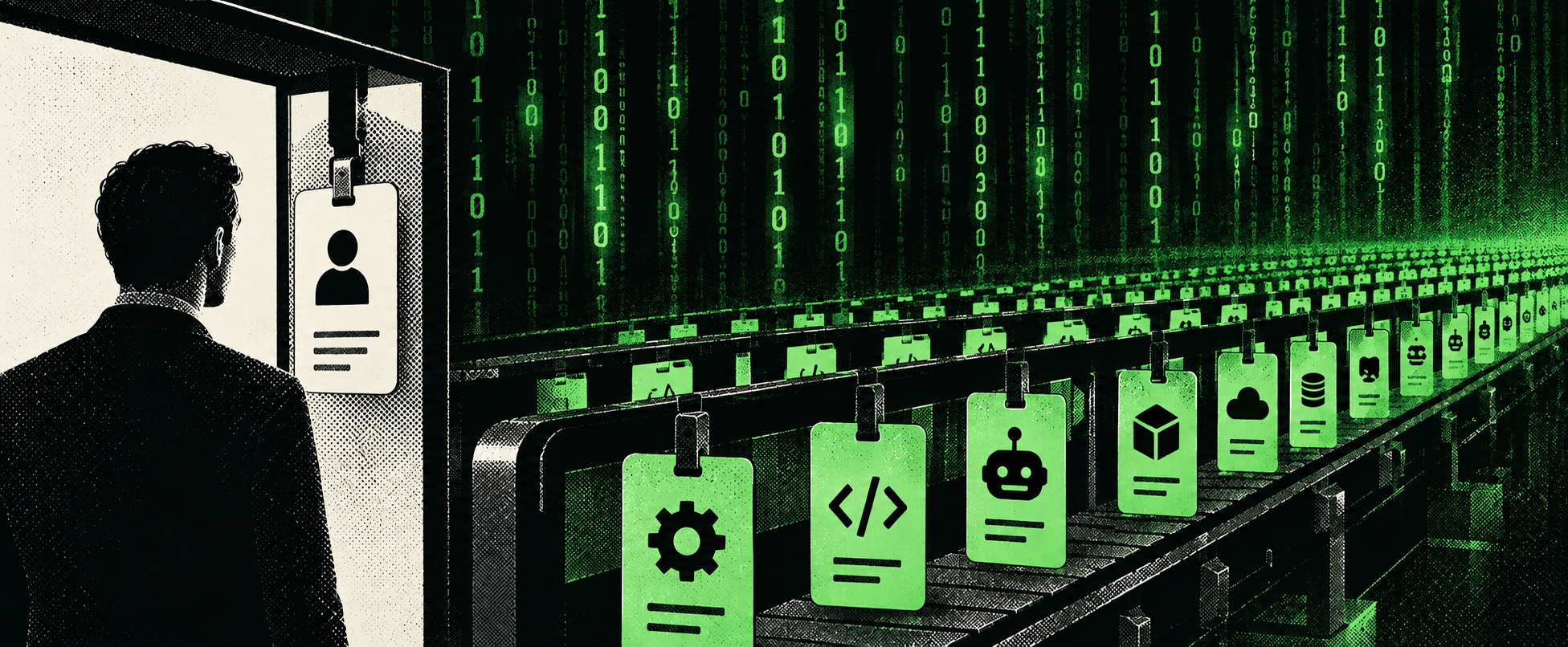
While security teams have spent the past decade hardening human authentication with MFA, conditional access, and passwordless login, a much larger population has quietly taken over enterprise environments: non-human identities (NHIs). Service accounts, API keys, OAuth tokens, workload identities, CI/CD credentials, and now autonomous AI agents collectively outnumber human users by ratios that industry research places between 40:1 and 90:1 in large cloud-native organizations.
This shift has not gone unnoticed by attackers. The 2023-2024 wave of breaches at Okta, Microsoft, and Snowflake-connected customers shared a common thread: compromised machine credentials—OAuth tokens, session cookies, or long-lived API keys—rather than a human typing a phished password. In several Snowflake customer incidents, attackers used credentials harvested from unrelated malware logs to authenticate directly to customer instances that lacked MFA enforcement on service accounts. No human ever clicked a phishing link.
Why Traditional IAM Programs Miss the Mark
Most identity and access management (IAM) programs were built around the human identity lifecycle: onboarding, role assignment, periodic access review, and offboarding. Non-human identities break every assumption baked into that model.
- They rarely expire. API keys and service account credentials are frequently provisioned once and forgotten, sometimes surviving for years past the project they supported.
- They are over-privileged by default. Developers under deadline pressure grant broad scopes—"just in case"—rather than the least privilege a workload actually needs.
- They are invisible to CMDBs. Shadow integrations, forgotten scripts, and third-party SaaS connectors create credentials that no inventory captures.
- They cannot use MFA. A service account can't respond to a push notification, so organizations often skip strong authentication entirely for machine-to-machine traffic.
The result is an attack surface that is large, poorly inventoried, and often exempt from the very controls that protect human accounts.
What the Frameworks Say
Regulators and standards bodies have started to catch up. NIST SP 800-207 (Zero Trust Architecture) explicitly treats workloads and devices as subjects requiring continuous verification, not just users. NIST SP 800-63B's credential lifecycle guidance is increasingly being applied to machine secrets, not just human passwords. The OWASP Non-Human Identity Top 10, published in 2024, catalogs the most common failure modes—improper offboarding, secret leakage in code repositories, and overprivileged service accounts among them—and maps directly to real-world incidents.
For organizations pursuing SOC 2 or ISO 27001 certification, auditors are now routinely asking pointed questions that many teams cannot answer confidently: How many active API keys exist in production? Which ones haven't been used in 90 days? Who owns each service account, and is that mapped to a human accountable party? Under ISO 27001:2022's Annex A control 5.16 (Identity Management) and 8.5 (Secure Authentication), non-human identities fall squarely within audit scope, even though many control narratives still describe only human user provisioning.
Practical Controls That Hold Up Under Audit
Security leaders don't need to reinvent IAM to close this gap—they need to extend existing zero trust and least-privilege principles to machine identities with the same rigor applied to humans.
1. Build a real inventory. You cannot secure what you cannot see. Tools that scan source code repositories, CI/CD pipelines, cloud IAM configurations, and secrets managers for hardcoded or orphaned credentials should feed a single system of record—ideally tied to a dedicated NHI or secrets management platform rather than a spreadsheet.
2. Enforce short-lived credentials by default. Wherever the platform supports it, replace static API keys and long-lived tokens with short-lived, automatically rotated credentials issued through workload identity federation (e.g., AWS IAM Roles Anywhere, Azure Workload Identity, or SPIFFE/SPIRE for hybrid environments).
3. Assign human ownership to every machine identity. Every service account and API key should map to an accountable owner and a business justification, reviewed on the same cadence as privileged human access—typically quarterly for high-risk credentials.
4. Apply conditional access to workloads, not just users. Modern identity providers increasingly support risk-based policies for service principals: restricting source IPs, requiring specific network paths, and alerting on impossible-travel patterns for token usage, mirroring the logic already applied to human sign-ins.
5. Kill credentials on offboarding—both human and project. When an employee leaves or a project is decommissioned, the associated service accounts, keys, and tokens must be revoked as part of the same workflow, not left dangling because "it might still be used somewhere."
The Coming Wave: AI Agents as a New Identity Class
The rise of autonomous AI agents adds urgency to this problem. Agents that call internal APIs, query databases, and take automated action on behalf of users introduce a new identity category that blends human delegation with machine execution—often with credentials scoped far more broadly than the task requires. Gartner and other analysts have flagged agentic AI identity governance as one of the top security priorities heading into 2026, and early adopters are already discovering agents provisioned with standing administrative access simply because it was the fastest way to get a proof-of-concept working.
Where Certification and Audit Fit In
For organizations preparing for SOC 2 Type II, ISO 27001, or industry-specific frameworks like HITRUST, non-human identity governance is no longer a nice-to-have control narrative—it is becoming a focal point of evidence requests. Auditors are asking for credential inventories, rotation logs, and ownership mappings with the same specificity once reserved for human access reviews.
Organizations that treat machine identity governance as a first-class discipline—not a byproduct of DevOps convenience—will find certification audits smoother and, more importantly, will close the exact gap that adversaries have been exploiting in headline breaches over the past two years. The identity perimeter of 2025 isn't defined by who logs in. It's defined by everything that logs in on their behalf.