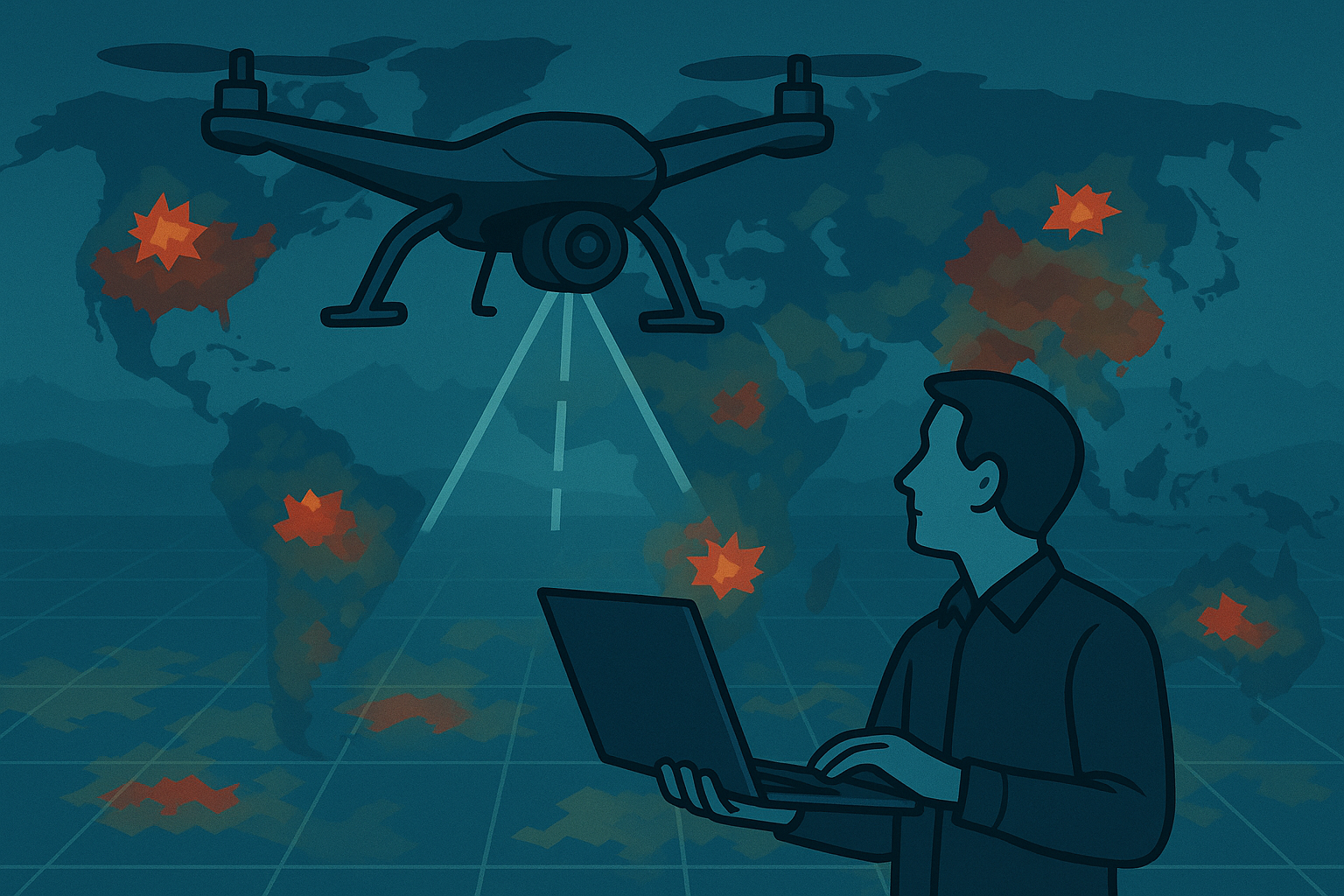
In less than a decade, the hum of a drone has become the soundtrack of modern war.
What began as tactical reconnaissance tools has evolved into a full-spectrum threat—capable of striking power plants, radar systems, ammunition depots, and even civilians hundreds of kilometres from the front. From the skies over Kharkiv to the outskirts of Tel Aviv, from U.S. bases in the Middle East to naval harbours in the South China Sea, the drone has turned every power substation, factory and data-centre into a potential battlefield.
But behind the visible swarms and fiery explosions lies another front—quieter, invisible, yet equally decisive. The software that connects, commands and defends those machines is now as critical as the drones themselves. That is why countries across the world are scrambling to secure not just the airspace, but the code that governs it.
The race for Industrial Internet of Things (IIoT) security expertise—once the domain of manufacturing and logistics—has suddenly become a matter of national defence.
From Factory Floors to Frontlines
IIoT was never meant for war.
It was born in the factories of Germany and Japan, where sensors and automated machines increased efficiency. It spread through energy grids, transport systems and hospitals. Each device—whether a pressure valve or a temperature probe—communicated with central servers through standardised, often unsecured, industrial protocols.
When the first generation of military drones emerged, their control systems borrowed heavily from that civilian infrastructure: commercial chips, open-source code, off-the-shelf telemetry modules. What made them cheap and scalable also made them vulnerable.
By 2022, during the height of Russia’s invasion of Ukraine, this reality became painfully clear. Both sides began jamming, hijacking and spoofing one another’s drones in mid-air. Entire fleets were lost to interference or false GPS signals. The conflict marked the birth of cyber-physical warfare—where the integrity of a drone’s firmware could determine the outcome of a battle.
Ukraine, facing constant barrages of Iranian-made Shahed drones and Russian Lancets, responded by building a digital defence network linking radar sensors, AI-driven recognition systems and intercepting drones in real time. That network, reliant on thousands of interconnected devices, was an IIoT ecosystem under fire. Protecting it required not only pilots and engineers, but a new breed of specialists—people fluent in both embedded systems and cybersecurity.
The Global Scramble for IIoT Defenders
Across continents, defence ministries and private contractors began searching for these elusive experts.
In Washington, the Department of Defense quietly added hundreds of “Operational Technology Cybersecurity” positions to its 2024 budget. In Brussels, NATO created a new working group on “Connected Battlefield Resilience.” In Seoul and Tokyo, universities began offering accelerated master’s programmes in embedded security for autonomous systems.
The numbers tell a story of desperation.
A recent U.S. Cyber Command report estimated a shortage of more than 35,000 qualified IIoT security engineersacross NATO member states. Israel’s Innovation Authority launched grants for start-ups focusing on “drone-to-infrastructure encryption,” while China’s Ministry of Industry and Information Technology listed “unmanned system cybersecurity” as a national strategic priority.
In each of these nations, the same paradox emerged: technology had outrun security.
Lessons from the Skies of Ukraine
Nowhere is this more evident than in Ukraine, where the sky itself has become a testing ground for the next generation of digital warfare.
When Russia launched its first mass drone raids on Kyiv in late 2022, Ukrainian engineers quickly realised that conventional anti-air defences were too slow and too expensive to counter dozens of small, autonomous drones arriving simultaneously. The answer lay in automation.
Within months, Ukraine’s IT Army—a hybrid of soldiers, hackers and volunteers—developed open-source software that allowed intercepting drones to be guided by real-time data from cameras, radars and acoustic sensors scattered across cities. Every one of these sensors was an IIoT node. The network fed into a central command platform that used machine learning to predict flight paths and assign interceptors accordingly.
But for each innovation, there came a new risk. The system’s connectivity made it a tempting target. Russian cyber units attempted to inject false data, spoof radar signals and overload communication channels. In early 2023, a successful intrusion temporarily blinded a segment of the defence grid around Odesa, causing several drones to slip through. Ukrainian specialists had to rebuild the affected servers from offline backups.
The episode became a case study in digital resilience. It demonstrated that protecting physical assets—from power plants to drones—now required cybersecurity architectures as robust as traditional air defences.
The Israeli Paradox
Israel, long considered a pioneer in both drone development and cyber defence, faced its own reckoning.
The country’s drone technology, exported for decades, suddenly turned against it when non-state actors began reverse-engineering captured systems. The October 2023 attacks on Israeli border installations revealed how militants exploited commercial drones fitted with improvised explosive devices and basic signal-jammers to bypass local defence grids.
In response, Israel mobilised an unprecedented cyber-industrial task force. The Israel National Cyber Directorate (INCD) partnered with leading universities to develop secure communication stacks for both military and civilian unmanned systems. One official described the goal succinctly: “Every drone is a computer with wings. If you wouldn’t connect an unprotected computer to the internet, why would you send an unprotected drone into the sky?”
Behind the rhetoric lay real anxiety. The nation that once defined electronic warfare now found itself fending off adversaries wielding $500 drones guided by smartphone apps. The focus turned to end-to-end encryption, firmware attestation, and artificial-intelligence-based anomaly detection.
By 2025, more than thirty Israeli start-ups were specialising in securing drones and industrial systems. But as one defence analyst noted privately, “Technology can’t solve ethics.” The same code that protects can also enable precision strikes. This ethical tension is reshaping how cybersecurity talent engages with defence industries worldwide.
Europe Awakens to the Drone Threat
Europe’s initial complacency evaporated in 2024 when drones began crossing its own borders—not as weapons of war but as tools of disruption.
In Germany, unidentified drones hovered over military training grounds and energy infrastructure. In France, flights were temporarily suspended at several regional airports after drone sightings near runways. Meanwhile, intelligence reports revealed attempts by state-sponsored actors to map European air-defence networks using autonomous reconnaissance drones disguised as hobbyist devices.
The European Union reacted by funding the Safe Skies Initiative, a consortium linking ENISA, the European Defence Agency and several national cyber commands. Its purpose: to establish continent-wide standards for IIoT device security and response coordination.
At the heart of the programme lies a simple recognition—air defence is now also network defence.
If a swarm of micro-drones can overwhelm a radar array, the countermeasure will depend as much on software that filters, prioritises and authenticates data as on the missiles that shoot them down.
To meet the challenge, Europe’s defence contractors are quietly pivoting. Airbus and Leonardo are hiring hundreds of embedded security specialists, not just aeronautical engineers. Their mission is to harden sensor networks, drone communication channels and autonomous control systems against hacking and signal manipulation.
The Eastern Acceleration: China, Japan, and Korea
In East Asia, the fusion of drones and IIoT technology is unfolding at industrial speed.
China’s state-backed manufacturers are producing millions of autonomous aerial and maritime platforms, from reconnaissance quadcopters to unmanned underwater vehicles. Many share components with civilian products—GPS modules, Wi-Fi transceivers, Bluetooth low-energy chips—creating a supply-chain challenge for Western security agencies that fear hidden backdoors.
At the same time, China’s cybersecurity apparatus is training thousands of engineers in embedded system defence. Military academies in Nanjing and Xi’an now offer degrees in “Autonomous Systems Security Engineering,” a discipline that blends robotics, network defence and AI.
Japan, historically cautious in military technology, has shifted dramatically since 2023. Following repeated incursions by unidentified drones near nuclear plants and military bases, Tokyo passed new legislation classifying IIoT and drone cybersecurity as national-security domains. The government launched a ¥120 billion “Secure Autonomy” fund to modernise defence contractors’ cyber capabilities.
South Korea, wedged between two technologically aggressive neighbours, is focusing on dual-use resilience. Its smart-city infrastructure—5G-connected traffic systems, ports and industrial parks—is now being hardened under military oversight, recognising that any large-scale drone or cyberattack could cripple both civilian and defence logistics.
The United States and the Return of Homeland Vulnerability
For the United States, the threat became tangible in January 2024 when a coordinated drone strike on a U.S. base in Jordan killed three service members. The incident prompted the Pentagon to accelerate its counter-drone and IIoT defence programmes. Within weeks, DARPA announced “Project Guardian,” aiming to secure the communications and telemetry layers that connect drone fleets, radar stations and automated anti-aircraft systems.
Homeland agencies also began treating drone defence as a cyber problem rather than purely a kinetic one. The Federal Aviation Administration expanded its remote-ID requirements, while the Cybersecurity and Infrastructure Security Agency (CISA) issued new guidance on securing local government infrastructure from drone-borne cyber payloads—small devices capable of intercepting Wi-Fi or Bluetooth communications while flying over cities.
Energy companies and airports were told to audit their IIoT devices for vulnerabilities that could be exploited by aerial vectors. For the first time, cybersecurity drills included simulated drone intrusions alongside phishing campaigns and ransomware outbreaks.
The message was clear: in the next conflict, a compromised network node could be as dangerous as an incoming missile.
Cybersecurity as a Nation’s Immune System
Historically, nations measured military power by tanks and aircraft. In the 21st century, they will measure it by resilience—the ability to withstand and recover from digital and physical disruptions.
The integration of IIoT security into national defence is transforming cybersecurity from a reactive service into a sovereign immune system. Every sensor, every drone, every controller becomes part of the body politic that must detect and neutralise intrusion.
This paradigm is already visible in Ukraine’s hybrid command centres, Israel’s drone-tracking grids, and Japan’s cyber-resilience labs. It represents a philosophical shift: cybersecurity is no longer about protecting data alone; it is about ensuring the continuity of a nation’s functions under attack.
The challenge, however, lies in coordination. Defence ministries operate alongside civilian agencies, private companies, and open-source developers. Each controls a piece of the puzzle, but their systems are intertwined. A vulnerability in a commercial weather sensor can cascade into a military radar feed; a compromised firmware update in a logistics drone can leak the position of supply convoys.
To manage such complexity, countries are experimenting with federated defence models—shared threat-intelligence networks linking public and private operators. NATO’s recent “Cyber Coalition” exercise simulated precisely this: how to maintain operational integrity when IIoT networks are compromised simultaneously across multiple nations.
The results were sobering. Even among allies, information-sharing protocols lagged behind real-time requirements. Many systems lacked common authentication standards. In some cases, drones from different countries could not securely communicate even when fighting on the same side.
The Ethical Frontier
As states militarise cybersecurity, ethical questions multiply.
What happens when protecting a factory network also means enabling autonomous weapons production? When defending a hospital’s IIoT systems doubles as training for battlefield resilience?
The dual-use nature of technology blurs the boundary between defence and offence. A specialist who designs encryption for drone telemetry can just as easily adapt that skill to disable an adversary’s fleet. Nations are aware of this ambiguity; recruitment campaigns often stress patriotism and national security, yet the same specialists later move into private defence firms serving foreign clients.
This revolving door has sparked debates reminiscent of the early nuclear era: who controls the expertise that can tip the balance of power? Some governments are exploring ethical codes for cybersecurity professionals, akin to medical oaths, though enforcement remains symbolic.
In parallel, civil-society groups warn that the proliferation of autonomous drones and AI-enhanced targeting systems risks normalising permanent surveillance and precision strikes far beyond the battlefield. The cybersecurity layer, once a shield, can become a sword.
Industry’s Reluctant Awakening
Defence budgets are rising, but private industry bears much of the burden. The same factories producing chips for electric vehicles now manufacture components for drone avionics. Semiconductor shortages during 2021-2023 revealed how dependent militaries are on civilian supply chains.
To mitigate this, governments are demanding “trusted foundry” certification for chips used in defence IIoT systems. Yet the reality is that a single compromised firmware update in a civilian factory could have national-security consequences.
Multinationals are therefore hiring chief resilience officers, merging cybersecurity with supply-chain oversight. Insurance companies are drafting new clauses that explicitly exclude losses from “drone-borne cyberattacks.” Energy and logistics firms are building in-house red-team units to simulate aerial and IIoT intrusions.
In effect, every sector touched by automation—transport, energy, healthcare—is becoming a forward position in the broader war for digital resilience.
The Human Bottleneck
Despite technological advances, the decisive variable remains human.
There are not enough engineers who understand both cybersecurity and the physical world of machines. An analyst who can defend a data-centre from ransomware might be lost when facing a compromised programmable-logic controller in a refinery. Conversely, an industrial-control specialist might not recognise a subtle intrusion through an AI-training dataset.
To bridge this gap, universities and military academies are revising curricula, merging mechatronics with ethical hacking. The next generation of defenders will need to speak two languages: the syntax of code and the physics of systems.
For now, the shortage persists. A NATO internal estimate released earlier this year noted that fewer than one in ten applicants for IIoT defence positions met the required cross-disciplinary criteria. Meanwhile, conflicts multiply, and drones keep flying.
What Comes Next
The next generation of warfare will not be defined solely by who owns the most drones, but by who can keep them secure, connected and autonomous under attack. Nations capable of maintaining operational continuity in a contested electromagnetic spectrum—where GPS may be jammed, networks flooded, and satellites blinded—will hold the advantage.
Cybersecurity, in this context, becomes the doctrine of survival. It is not merely about preventing breaches but ensuring that the system, like an organism, heals faster than it is wounded.
Some analysts foresee a future in which every country maintains a “Digital Civil Defence Corps,” a reserve of certified IIoT and cybersecurity specialists ready to mobilise during crises, much like firefighters or medical personnel. Others predict the rise of international norms akin to the Geneva Conventions, establishing limits on cyber-physical attacks against civilian infrastructure.
What is certain is that the lines between civilian and military, network and battlefield, are gone. The world’s infrastructure has become the front line—and defending it will define this century’s balance of power.